
Category: Blogs: Creative
(Entries: 2, 4, 5)
ENGL202 Blog 5 – Creative: Language’s Liberation and Enslavement
ENGL202 Blog 5 – Creative: Language’s Liberation and Enslavement
TASK: 1/ Write a poem or a short prose passage that illustrates the ways in which language can be both a prison and a release from prison.
Words can be gorgeously cruel. Cold and clean and quiet as they confirm your illness after months of blood tests and bone density scans. Words can be awfully kind. ‘I do,’ she whispers with tears shiny as the diamond on her pale, manicured hand.
Words can wind around you–a trickster crawling up your sibilant spine–a bilingual zephyr to seal your promises and read your palms. The words of her or him or them or you…oh, words play hopscotch with your hope and are the cement and soul in your thoughts. These letters–these hieroglyphs–these keys to the kingdom.
These syllables–this syllabus–these syntactic prison sentences.
I remember my father’s ancient language; it was fast and harsh and loud. Truly musical, it sent me to sleep at night. A sad discussion with a village on the other side of the other world was my white noise machine.
Hausa is what they called it.
When I was small, I saw the language in my mind: it had a shape and a voice and a smell. The light of the garage was on, and the cup of tea was steaming, and my father’s impenetrable realm was teeming with melodic gibberish. It sounded as if he was casting spells, he rounded the worktable like chanting around a cauldron. Never had I ever felt so helpless and so fascinated. It was a secret power I had no access to.
It was the cotton candy grass on the other side the fence.
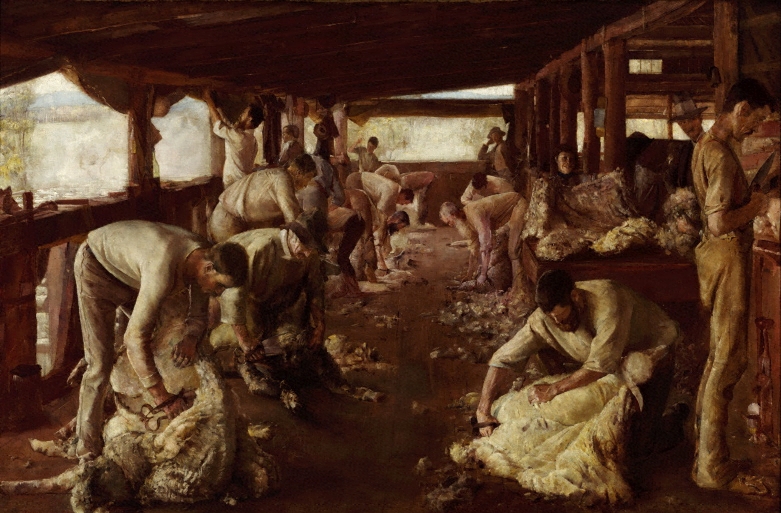
Blog 2: Creative – Inspired by Dame Mary Gilmore’s ‘Australia’ and Tom Roberts’ ‘The Golden Fleece’
“Water,” you bellow, and I scramble to the kitchen to fetch a pitcher.
Inspiration: Week Four readings and lectures established the development of the early Australian identity. Throughout, I noted a connection between Tom Roberts’ ‘Golden Fleece’ and Mary Gilmore’s ‘Australia’, linking the Australian identity to Greek Mythos.
‘The Ilweme’s Wife’ sort of manifested from my prior understanding of Greek mythos, some readings from the Pen Anthology of Aboriginal Literature (just as some extended reading) and the readings and artworks from Week 4. I felt I couldn’t creatively relate to the writings of Lawson or Patterson, so I chose a different perspective. I don’t have any Indigenous Australian or First Fleet heritage, so this isn’t technically ‘my’ story or the story of my ancestors, but I know I can relate to an appreciation of nature and earth because of my West African roots.
I found myself oddly inspired by Gilmore’s mentioning of Hades and found myself envisioning the God of Death as an outback shearer–hard yakka and rough manners–presiding over his land with dominance and vulgarity, attaining the ‘Golden Fleece’ of Australia: the hero’s loot of mother earth (natural resources and land to cultivate).
But whose land was he was really rearing? According to the myth, Hades had stolen Persephone–the Greek personification of nature and earth–and I felt I could not ‘Australianise’ Persephone’s connection to earth without translating it through the eyes of a captured Arrernte (Arunta) woman from Central Australia, a slave bound interminably to the stockman, stolen from her mother and longing for the connection to country and culture.
The title itself is a nod to Henry Lawson’s “The Drover’s Wife”, a story of the hardships in the outback. ‘Ilweme’ means “dead” in the Arrernte language. Therefore, we are reading a story of The Dead’s Wife.
Acknowledgment of Country and Culture {for use of Arrernte language}: I acknowledge and respect the traditional custodians whose ancestral land, traditions and language I am implementing throughout my fictional work. I acknowledge the deep feelings of attachment and relationship of Aboriginal peoples to country. I also pay my respects to the cultural and linguistic authority of the Aboriginal peoples of Central Australia who are reading this work.
“Mark where, fallen, the tribes move in the shadow:
Wilde, W.H. “Australian Dictionary of Biography.” Biography – Dame Mary Jean Gilmore – Australian Dictionary of Biography, http://adb.anu.edu.au/biography/gilmore-dame-mary-jean-6391.
Dark are the silent places were Arunta walks
Dark as the dim valleys of Hades, where stalk,
grey-shaped, the heroes and the gods of the Greeks.
These were the young, for even then Arunta was old.”
The Ilweme’s Wife
“Water,” you bellow, and I scramble to the kitchen to fetch a pitcher.
You emerge from the shed covered in red dust, angry sweat and white wisps of the animals. Snatching the jug from my grasp, you keep me from escaping with a rough grip on my hip.
You want me to watch you swallow the water, so I turn my eyes to the sun.
Those indigo eyes of a dingo–this hungry akngwelye artnwere. My gaze can only touch the white fibres in your facial hair. When you seek me at nightfall–as Eros visits Psyche in the silent, swallowing dark–you tell me those embers of white in your urrperle beard are the closest thing I shall ever taste to snow. If only you knew it was I who begged my mother to sketch into kwatye akantyere the first snowflakes of Kosciuszko.
If you are the king of the ilweme, your domain is indeed vast, but this country is not your kingdom–no more yours than it is mine, you foolish outback idol. This is not your province – this land I touch and love and mourn. This country you say you’ve claimed is my atyemeye, and I feel her wails encase me as the kwatye pere splits across the plane.
If the land is my atyemeye, then you are the god who has taken me from her. Still, I stand upon the cradle of her yenpe and hear her voice beckoning, ‘Daughter, come home. Come home.’
But her whispers are muffled by the calamity of the workmen on the cattle station.
And every night you call me with the light of the Southern Cross on your pale Olympian flesh, yet you do not realise it is the starlight of all amiwarre that has defied your rule. You capture me and the name clenched between your teeth is…Persephone. You do not see that I am older than that name–older than the life of the flower child stolen by the death god.
I hold memories older than even your immemorial name.
The pantheon of gods in the shed resumes their plunder of the animals. You’re an ocker and an oaf, yet your commands are obeyed among the bleats of both shearers and sheep. Always in pursuit of that perfect cut of sheep’s coat–a shearer ever seeking the Golden Fleece.
I return to my chores and listen as werneme calls, ‘come home, daughter. Come home.’
“Akarelheme,” I say, though I think you know I have forgotten what this means.
~ fin ~
Arrernte Vocabulary:
- akngwelye artnwere – dingo
- urrperle – black
- ilweme – dead
- kwatye pere – lightning
- atyemeye – mother
- yenpe – skin
- amiwarre – the Milky Way (stars in the sky)
- werneme – the blowing wind
- akarelheme – wait
“Arrernte Vocab.” Memrise, https://www.memrise.com/course/173460/arrernte-vocab/.
Blog 5: Creative – That Deadman Dance
Author’s Note: Being of African and European descent, I understand how tricky the fusion of cultures can become. I everyday feel blessed that I had parents who came from different parts of the world. I’m glad to know how the dichotomy of humanity can be the most complex and confounding experience for one person.
Reading ‘That Deadman Dance’, a moment in the book that struck me was when Bobby’s niece and nephew visited. I wondered at their personal experience as biracial individuals in colonialist Australia.
I was brought back to the memory of meeting my paternal grandfather in Ghana for the first time when I was very little; there was such wisdom, joy and melancholy within him all at once. He appreciated that I wanted to learn about the reality of my people.
This piece is a culmination of the feelings I experienced listening to my grandfather’s spirit in the mythological stories I remember from Ghana. It is an imagining of Bobby’s relatives’ interactions with the Noongar and the English, envisioning how dispossession is perceived by an individual forged of both the coloniser and the indigenous.
“6 years I’ve been in the desert
Neil Murry ‘My Island Home’
and every night, I dream of the sea
they say, ‘home is where you find it.’
will this place ever satisfy me?
for I come from the saltwater people
we’ve always lived by the sea
now I’m out here west of Alice Springs
with a wife and a family”
Jak Tar & Binyan’s children visit their Uncle Bobby

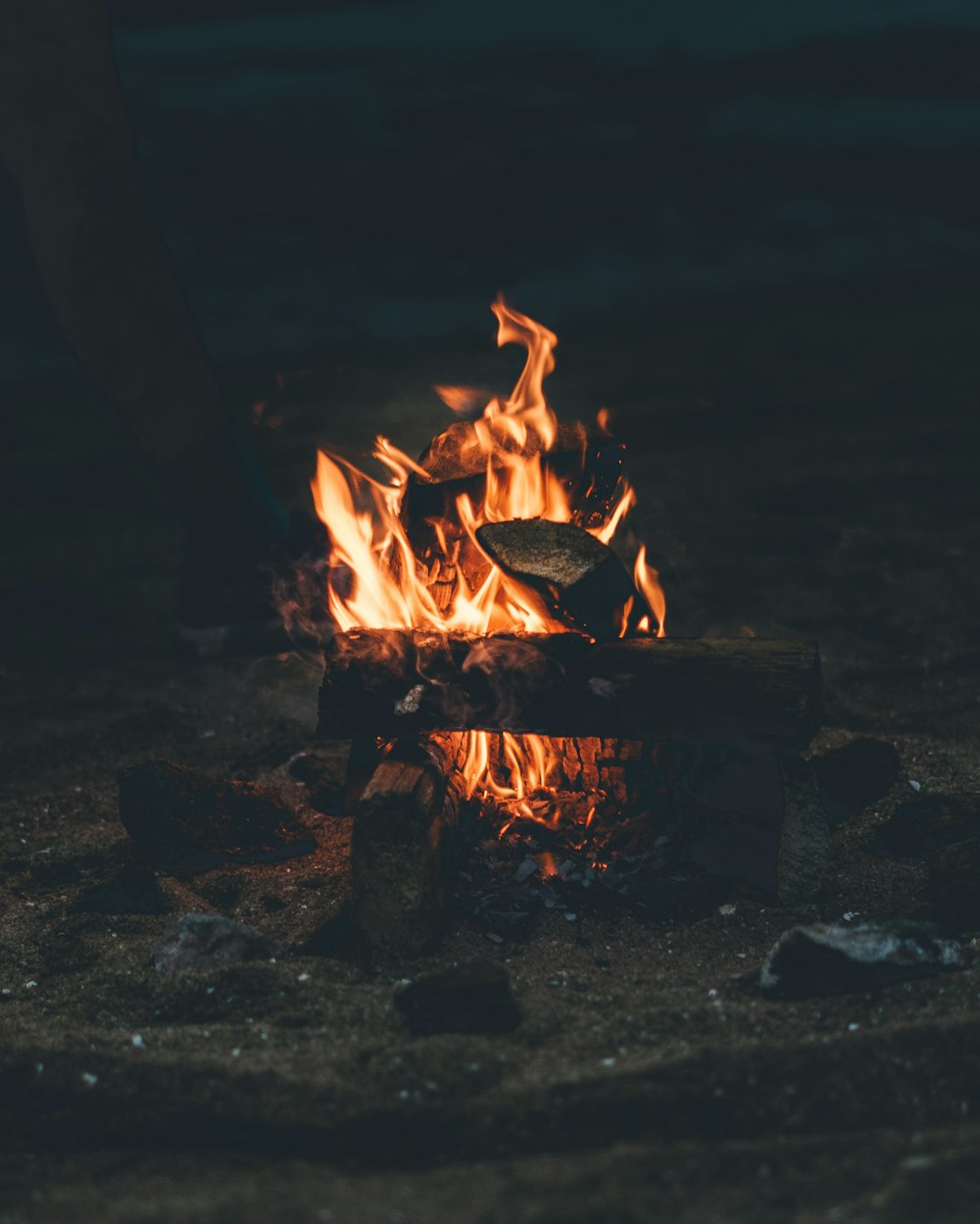
A lonely man on the shoreline, he sits with the fire and the sea.
The townsfolk say, “Oh, Old Bobby Wabalanginy, yes, he’ll be speaking his stories.”
The townsfolk say, “You’ll find him singing to the wind and the whales.”
The townsfolk say, “That mad, ol’ blackfella who won’t shut his gob.”
My brother and I wave to Uncle Bobby from the oldest path in this place: the town to the sea.
He waves back. White teeth glisten against flesh stained with ochre and a frizzy, grey-stroked mane roaring in the wind. Uncle Bobby beckons us toward the pulsating glow of his campfire.
I run to him barefoot and my brother scoffs at the sand in his shoes.
Uncle Bobby engulfs us both with weak arms and strong embrace, murmuring Noongar words of welcome into the shells of our ears. As if we are the very shells on this beach, he talks to the saltwater inside ourselves–inside our veins.
Our Papa says, “You and your brother and your mother, you don’t bleed blood. You bleed the ocean and rivers, it’s part of you.”
This Mabarn man smells of the Holy Trinity: the sea and the land and the man.
Ushered around Uncle Bobby’s campfire, he builds it up hot for us and hums in baritone brooding. My brother mutters about the stench of smoke soaking into his new coat and I close my eyes with the ash colouring my cheeks like a strange rouge.
My brother looks to the town longingly. A girl of flaxen curls and cerulean eyes passes us, holding a parasol to the sun, and the woman beside her looks to Bobby with an inquisitive gaze.
“Governor’s wife,” he says in a faraway voice.
“His daughter, too?” My brother asks.
I turn to Uncle Bobby – his large, black eyes alight in the flames. “Tell me about the whales, Uncle Bobby,” I say with delicate distraction on my smile and he knows I mean to take him from thoughts of the past. He knows I ask him to tell me about the past before the past…a time before time.
Though my brother’s eyes follow the governor’s wife and daughter, Uncle Bobby looks to the ocean and so do I. We watch the waves catch on the sunset, the shadow of spirits leap from crest to crest.
“I see them, Uncle Bobby,” I say and pretend I do not notice the tears fall into the old man’s fire. “I see them.”
Blog 4: Creative – Dear Meg Hogben
4/Write a letter to Meg in “Down at the Dump” telling her what you think about her relationship with Lummy.
Meg,
I’m so sorry to hear about your Aunt Daise.
If the red-hot grief of losing someone who understands you is not hard enough to bear, I couldn’t blame you for mourning the even gloomier, greying knowledge of being surrounded by those who don’t understand you at all. Believe me when I say that I know your feelings, Meg. Losing my own mother was–well, even the words of poets evade me. Realising there was nobody else in the world who would see the world the way we could see the world was more than half the agony.
Just keep shining, Meg. And know you are loved.
Yes, your parents are the incarnate of taupe walls and 4.5-star motels and always carrying a spare pair of flesh-coloured high heels in the boot of the second-hand Jag (the colour of ‘flesh’ always being white, of course). However, I’m sure they do love you with brightest beige they can muster. It’s simply a sad fact that you love in kaleidoscopic shades transcending the human eye.
And you were – and still are – loved by Daise with the same otherworldly passion you have.
And loved by Lum, it seems. Your last letter said as much.
Even your love for Lum outstretches Daise’s love for that fine, though pitiable Mr. Cunningham. Lum, too, is quite fine (picture me now, friend, winking at you and nudging you in the ribs with a tickled elbow and suggestive smirk). You see that Lum can defy pity, just as Mr. Cunningham could not. Lum asks for none of our sorrow; he’s a proud, poor, unpitiable boy. And maybe that is the solid shade of faithful rigidity you deserve: the blackness in the finite, in the bitchumen roads he’ll travel. Not Hogben beige, but rather a Lum-like absence of colour (or his desire for that absence) to balance even half the light you emit.
I can picture your cherry blossom cheeks and hidden smile at reading these very sentiments.
And you’d be right to hide that smile, Meg. Perhaps for only a few years more…perhaps for a lifetime. Keep your blushes and your smiles for Lum in the crevasses of your soul. Daise didn’t have those crevasses I believe; she couldn’t contain that luminosity in the ravines of her spirit. Whether it was because her compassion held no penchant for secrecy or because she felt true light shouldn’t be quietened, she didn’t have the capacity for protection. She only knew exhibition of that precious, unchiselled jewel underneath her skin.
But you know, Meg. You know how to protect what must be protected.
Because it isn’t the night-black certainty of Lum’s unwayward path to the semi that concerns me. Rather, it’s others’ “concern” that concerns me. We both know the folks of Sarsaparilla, Meg. We both know the affronted stares and the utterances under the breath. If you’re not concerned for you, be concerned for the both of you: the unity of you and Lum. That’s what makes people look twice. That’s what made folks look twice at my parents. Same as you and Lum: the white and the black and the world in between. The world’s what drove them apart, too, eventually.
Don’t misunderstand me, Meg. I am so happy you have found Lum. He’s your match in more ways than none. But this world can be cruel. And you’re both so young. You’re strong and clever enough to understand that. Give yourself time in the cool shade of this boy. He’s so eager to escape this place that all he’s got now is the right one on whom to wait: you.
Your friend,
Mebs
 Mariama E. Biro Saibou