
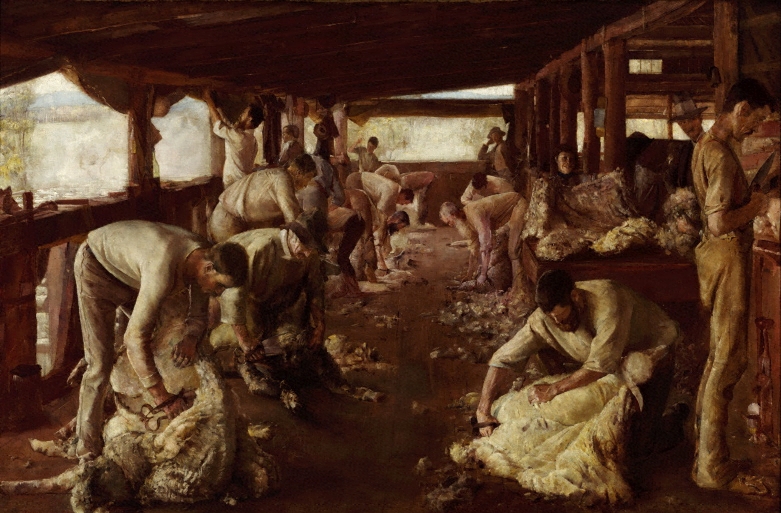
Inspiration: Week Four readings and lectures established the development of the early Australian identity. Throughout, I noted a connection between Tom Roberts’ ‘Golden Fleece’ and Mary Gilmore’s ‘Australia’, linking the Australian identity to Greek Mythos.
‘The Ilweme’s Wife’ sort of manifested from my prior understanding of Greek mythos, some readings from the Pen Anthology of Aboriginal Literature (just as some extended reading) and the readings and artworks from Week 4. I felt I couldn’t creatively relate to the writings of Lawson or Patterson, so I chose a different perspective. I don’t have any Indigenous Australian or First Fleet heritage, so this isn’t technically ‘my’ story or the story of my ancestors, but I know I can relate to an appreciation of nature and earth because of my West African roots.
I found myself oddly inspired by Gilmore’s mentioning of Hades and found myself envisioning the God of Death as an outback shearer–hard yakka and rough manners–presiding over his land with dominance and vulgarity, attaining the ‘Golden Fleece’ of Australia: the hero’s loot of mother earth (natural resources and land to cultivate).
But whose land was he was really rearing? According to the myth, Hades had stolen Persephone–the Greek personification of nature and earth–and I felt I could not ‘Australianise’ Persephone’s connection to earth without translating it through the eyes of a captured Arrernte (Arunta) woman from Central Australia, a slave bound interminably to the stockman, stolen from her mother and longing for the connection to country and culture.
The title itself is a nod to Henry Lawson’s “The Drover’s Wife”, a story of the hardships in the outback. ‘Ilweme’ means “dead” in the Arrernte language. Therefore, we are reading a story of The Dead’s Wife.
Acknowledgment of Country and Culture {for use of Arrernte language}: I acknowledge and respect the traditional custodians whose ancestral land, traditions and language I am implementing throughout my fictional work. I acknowledge the deep feelings of attachment and relationship of Aboriginal peoples to country. I also pay my respects to the cultural and linguistic authority of the Aboriginal peoples of Central Australia who are reading this work.
“Mark where, fallen, the tribes move in the shadow:
Wilde, W.H. “Australian Dictionary of Biography.” Biography – Dame Mary Jean Gilmore – Australian Dictionary of Biography, http://adb.anu.edu.au/biography/gilmore-dame-mary-jean-6391.
Dark are the silent places were Arunta walks
Dark as the dim valleys of Hades, where stalk,
grey-shaped, the heroes and the gods of the Greeks.
These were the young, for even then Arunta was old.”
The Ilweme’s Wife
“Water,” you bellow, and I scramble to the kitchen to fetch a pitcher.
You emerge from the shed covered in red dust, angry sweat and white wisps of the animals. Snatching the jug from my grasp, you keep me from escaping with a rough grip on my hip.
You want me to watch you swallow the water, so I turn my eyes to the sun.
Those indigo eyes of a dingo–this hungry akngwelye artnwere. My gaze can only touch the white fibres in your facial hair. When you seek me at nightfall–as Eros visits Psyche in the silent, swallowing dark–you tell me those embers of white in your urrperle beard are the closest thing I shall ever taste to snow. If only you knew it was I who begged my mother to sketch into kwatye akantyere the first snowflakes of Kosciuszko.
If you are the king of the ilweme, your domain is indeed vast, but this country is not your kingdom–no more yours than it is mine, you foolish outback idol. This is not your province – this land I touch and love and mourn. This country you say you’ve claimed is my atyemeye, and I feel her wails encase me as the kwatye pere splits across the plane.
If the land is my atyemeye, then you are the god who has taken me from her. Still, I stand upon the cradle of her yenpe and hear her voice beckoning, ‘Daughter, come home. Come home.’
But her whispers are muffled by the calamity of the workmen on the cattle station.
And every night you call me with the light of the Southern Cross on your pale Olympian flesh, yet you do not realise it is the starlight of all amiwarre that has defied your rule. You capture me and the name clenched between your teeth is…Persephone. You do not see that I am older than that name–older than the life of the flower child stolen by the death god.
I hold memories older than even your immemorial name.
The pantheon of gods in the shed resumes their plunder of the animals. You’re an ocker and an oaf, yet your commands are obeyed among the bleats of both shearers and sheep. Always in pursuit of that perfect cut of sheep’s coat–a shearer ever seeking the Golden Fleece.
I return to my chores and listen as werneme calls, ‘come home, daughter. Come home.’
“Akarelheme,” I say, though I think you know I have forgotten what this means.
~ fin ~
Arrernte Vocabulary:
- akngwelye artnwere – dingo
- urrperle – black
- ilweme – dead
- kwatye pere – lightning
- atyemeye – mother
- yenpe – skin
- amiwarre – the Milky Way (stars in the sky)
- werneme – the blowing wind
- akarelheme – wait
“Arrernte Vocab.” Memrise, https://www.memrise.com/course/173460/arrernte-vocab/.
 Mariama E. Biro Saibou
This is a very interesting blog post Mariama for many reasons: it’s linking of the various cultures together and its respect of indigneous cultures in particular. But you need to make clearer how The Ilweme’s Wife fits into your narrative and where this story is from…. can you do that? Is it perhaps your own story??? All this is not clear to your reader :)- you can answer me via email….
MG
Editing Needed (and some workshop follow-ups- see Purdue Owl for help: http://owl.english.purdue.edu/owl/section/1/
* connoting the Australian identity to Greek Mythos. = LINKING the Australian identity to Greek Mythos. [ ]
*But who’s land = But whose land – [whose or who’s [who is] : See http://humbleapostrophe.com/apostrophes/whose.html; who, whom and which: http://owl.english.purdue.edu/owl/resource/645/01/%5D
LikeLike
PS… my use of it’s (in my comment needs correcting!) it’s=it is [this is one of those odd exceptions in the English Language where the normal use of ‘s for possessive case or ownership has been upstaged.] I should have used “its” NOT “it’s
LikeLike